
Spend Smart, Protect the Piglet Gut

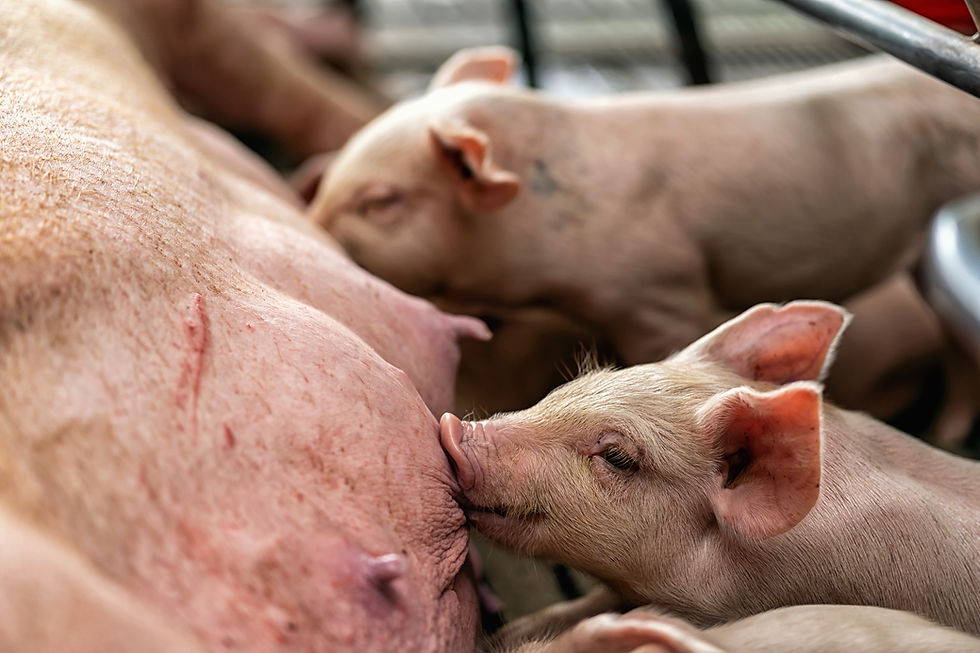
Feed is the biggest bill in pig production, so the obvious move is to cut its cost. But where you cut matters. Benchmark data show that the cheapest place to save is not necessarily the most expensive feed on the farm.
Where the Feed Budget Goes
A 2025 Southeast Asian benchmark tracked a pig from 6 kg to 125 kg. The pig consumed about 297 kg of feed, at a total feed cost of roughly 4,417 THB per pig. But the cost is not evenly distributed across production phases:
Phase | Body Weight | Share of Feed Cost |
Nursery | 6–25 kg | 11.1% |
Grower | 25–75 kg | 39.5% |
Finisher | 75–125 kg | 49.4% |
Nursery feed is the most expensive per kilogram — around 28 THB/kg for the first pre-starter compared with 13.3 THB/kg for late-finisher feed — yet it accounts for only about a tenth of total feed cost.
Why? Young pigs simply eat much less.
By contrast, the finisher phase accounts for nearly half of the total feed bill because pigs consume the greatest volume of feed at this stage.
Across all phases, energy ingredients typically account for 50–60% of feed cost, while protein ingredients contribute around 30–45%. Additives and micro-ingredients represent only 5–10%, but their impact on performance and profitability can be much greater than their share of the feed bill suggests.
Why the Young Pig Is Different
The obvious response to the high price of starter feed is to look for ways to reduce its cost. But this is where careful nutrition matters most.
Weaning is one of the most challenging stages in a pig's life. Digestive capacity is still developing, and nutrient digestibility is lower than in older pigs.
Amino acid digestibility is around 78–84% in nursery pigs, compared with 84–89% in growers and 88–93% in finishers. Several factors contribute to this challenge:
Post-weaning stress
Low feed intake
Immature enzyme secretion
Changes in stomach acid production
Villus atrophy after weaning
An immature gut microbiome
A pig that gets off to a poor start can struggle to catch up later. The nursery should therefore be viewed as an investment in lifetime growth and performance, rather than simply another opportunity to reduce feed cost.
Protecting the Gut in the Nursery
The priorities are simple: get piglets eating and keep the gut healthy.
Start before weaning with a highly palatable creep feed.
Make feed easy to access: provide multiple feeders, offer fresh feed several times a day, and ensure easy access to water.
Consider low-level acidification, where appropriate, to support feed intake and digestive conditions.
Moderate crude protein and balance it with synthetic amino acids, which can help reduce excess nitrogen and support gut health.
Formulating diets using standardized ileal digestible (SID) amino acids, rather than total amino acids, supports this approach.
Total amino acid values can overestimate what the pig can actually digest and use, with the difference particularly relevant in young animals. SID provides a more practical basis for comparing ingredients and matching the diet to what a weaned pig can utilize.
Saving Money Where It Counts
Once the pig moves beyond the nursery, the economics change.
The grower and finisher phases together account for about 89% of total feed cost. This is where ingredient-cost optimization can have the greatest financial impact.
The goal is not simply to select the cheapest ingredients. It is to use lower-cost ingredients efficiently, meet the pig's SID nutrient requirements, and maintain growth and feed efficiency.
At these feed volumes, even a small saving per kilogram can add up to a meaningful reduction in cost per pig.
The Takeaway
Spend strategically in the nursery. Good starter feed and gut protection represent a relatively small share of total feed cost but can influence lifetime performance.
Save in the grower and finisher phases. Together, they account for about 89% of feed cost, making them the key areas for cost optimization.
Formulate on SID, not total amino acids. It provides a more accurate picture of the nutrients the pig can actually digest and utilize.
The lowest feed cost per pig does not necessarily come from the cheapest starter diet. It comes from producing a healthy pig that maintains strong growth and feed efficiency throughout its lifetime.
Understanding where to invest, where to optimize, and how nutrition connects with gut health is an important part of effective swine production management.
At the Swine Production & Management AgriSchool in Bangkok, Thailand, participants explore these practical connections between nutrition, gut health, disease prevention and farm performance through expert-led learning and real production challenges — helping turn technical knowledge into better decisions on the farm.


